
When a Timeline Becomes a Threshold

The right tools are a start to good facilitation. But you can’t get very far in facilitating teams unless you are open to adapting to the changing dynamics, and open to the nudge of your own experience and intuition.
Jacobien Vermande specialises in visualising business issues and talks us through a situation where just plain visualisation would simply not have cut it.
Over to Jacobien!
Warmly,
Jonathan
Sometimes, a wall full of paper is not just a record of history—it’s an invitation to step into it.
I was called in to do a reflective session on an ongoing programme for a local government organisation recently. The programme was implemented with a strong leadership push and a distinct hair-on-teeth energy. Hardly the safest ground for introducing diversity and inclusion as a shared, collective way of working within an organization.
People who had been made responsible for the implementation felt pushed rather than supported, rushed rather than invited. The fact that this unfolded during COVID only amplified the strain. What followed were years of internal friction between HR and other departments—tension that, when we gathered for our reflective session, was still palpably present in the room.
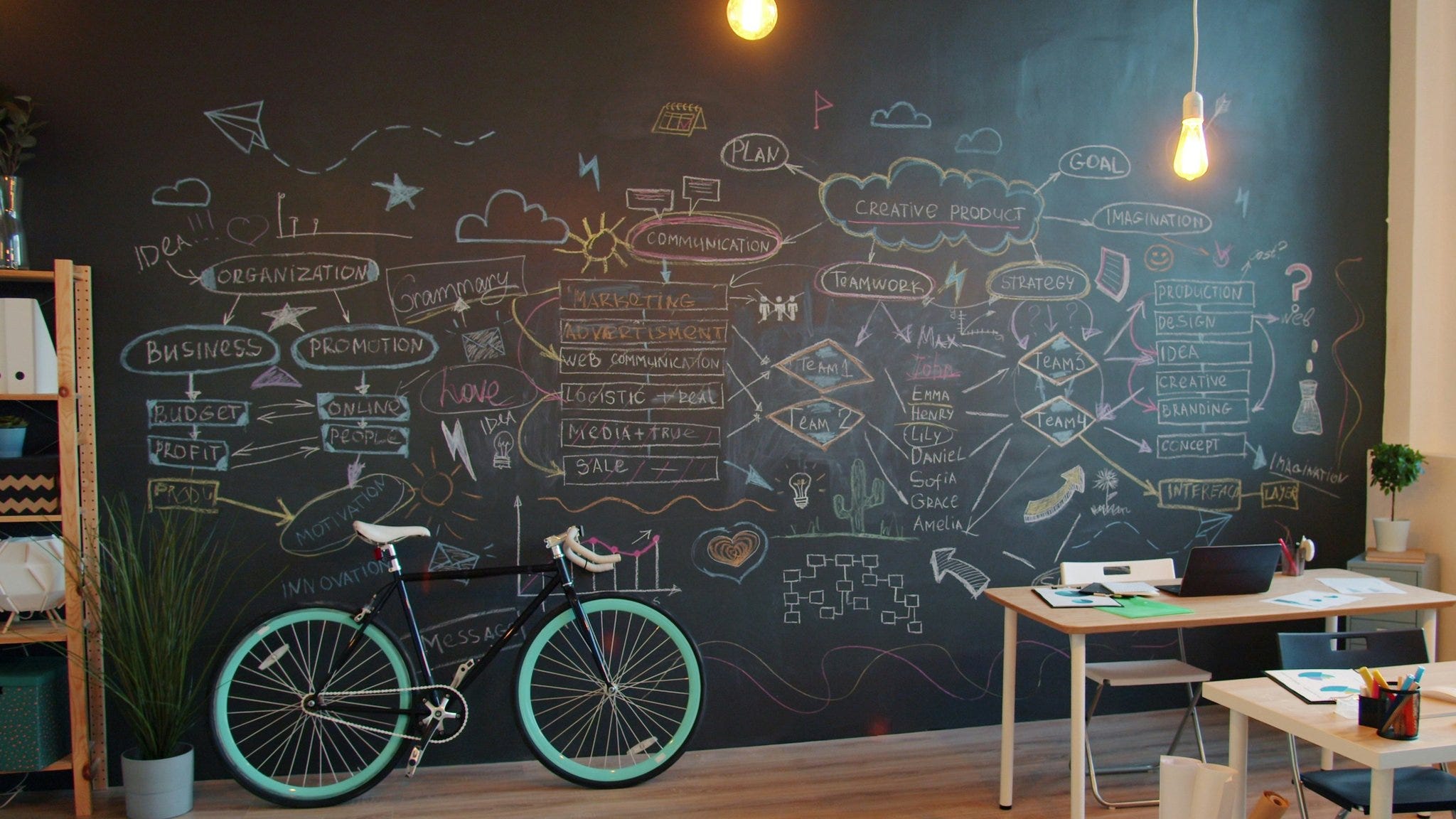
Providing a Visual Structure for Team Clarity
The purpose of the session was to look back: to distil insights, celebrate what had worked, and decide what to carry forward. To support this, we created a large visual timeline spanning the full length of the room—about ten metres of wall.
Each year from 2020 to the present was marked, with A4-sized successes and realisations attached to each period. The timeline functioned as a shared external memory: a cognitive reference to help people orient themselves in time and reconnect with the journey so far.
And yet, as the session unfolded, it became clear that staying at a purely cognitive level wouldn’t be enough. Something essential remained out of reach. The energy in the room called for a different entry point, one that tapped not only into what people remembered, but into what they had lived.
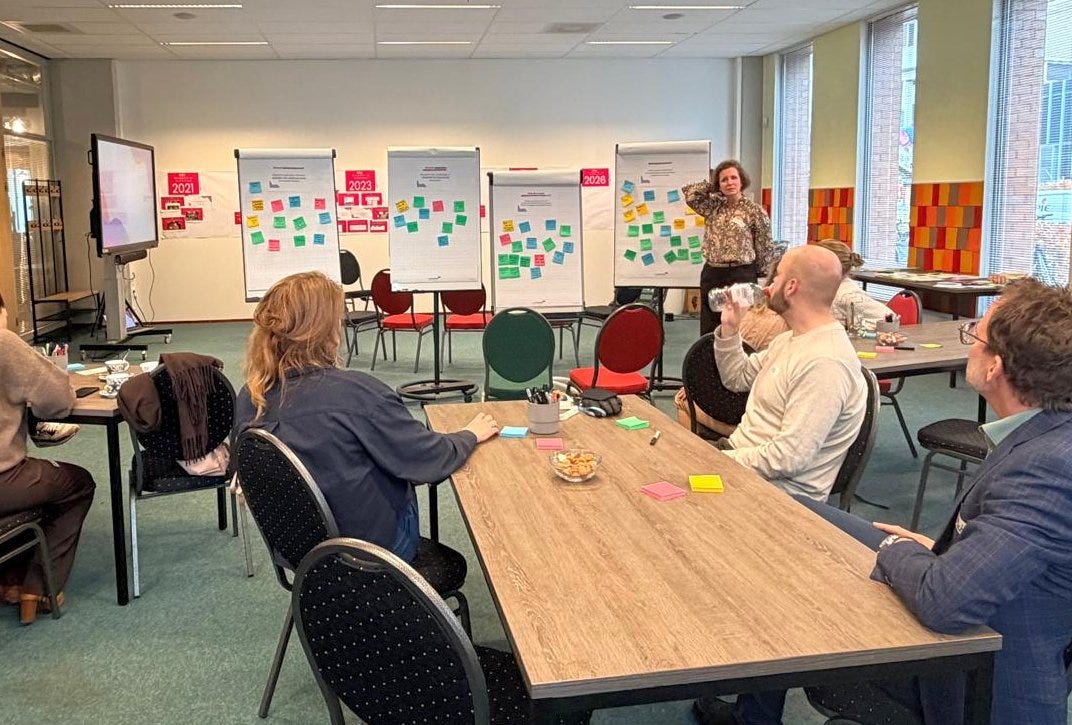
Beyond Visual Representation into Experience
Intuitively, I invited participants to physically position themselves on the timeline at the point where they had entered the programme.
The effect was immediate. The group spread out: three people who had been there from the start, two relative newcomers who had joined mid-2025, and the rest distributed across the intervening years.
This simple spatial shift changed the conversation entirely.
People were no longer speaking about the programme from a single present-day perspective; they were speaking from their lived position within it. The ‘old-timers’ voiced their frustrations and disappointments. The ‘newbees’ shared how the programme currently functioned for them—what was working now, what had clearly evolved.
Grievance gave way to relief. The darker tones of the early years softened as the present moment blew through the room like fresh air. Slowly, a sense of pride entered the collective: despite the rough beginnings, something valuable had been built.
Visuals used as supporting artefacts in facilitation are not just aids to cognitive processing; they function as safe anchors for (re-)entering experience.
Facilitation as a Living, Intuitive Practice
This is where an intuitive way of facilitation comes into play. Sometimes, the role of the facilitator is not to introduce a new tool, but to sense when an existing one can be activated differently.
Visual elements like timelines are not just informational devices; they can act as thresholds. They help define scope, create safety, and anchor what might otherwise become diffuse or overwhelming.
Without boundaries, a facilitator can easily drift into territory that belongs elsewhere. That said, working more intuitively is not without risk. In this case, the timeline provided a clear container. It framed the exploration in time, kept the focus collective rather than personal, and ensured the depth remained appropriate for the context.
Recontextualising For Results
The result was a renewed, shared understanding of the past and a more grounded relationship with the present. The group could finally acknowledge both the cost and the value of what they had created. And from that place, it became possible to move forward with clarity and confidence.
When the right visual support is used, facilitation becomes transformative as it moves beyond representation into experience. The most powerful shift is often not what people talk about, but where they are invited to stand within that experience. Visual structure holds the line, allowing intuition to do its work safely.
Jacobien Vermande is a business visualization partner at Joone Graphics coming from a 15-year stint in clinical research and running trials. She now helps organisations with their own health by conducting training in visual thinking and facilitation, and as a business consultant and Obeya coach.